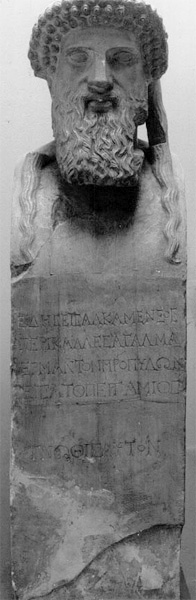
| Discussion: |
Herms stood on street-corners and outside houses (propylaios means 'outside the gate') to ensure good luck and prosperity to the city and her people; they were originally a manifestation of Hermes as a fertility god, which is why the mutilation of the Hermae on the eve of the Sicilian Expedition (415 B.C.) was considered an act of extreme sacrilege. Alkamenes, according to the Suda, was a Lemnian; possibly he was raised in the Athenian cleruchy on the island established around 450 B.C. He seems to have been contemporary with, and was perhaps apprenticed to, Pheidias. Alkamenes worked in chryselephantine, bronze, and marble, tackling similar subjects to those of Pheidias. There are two versions of the Hermes Pro |