| Discussion: |
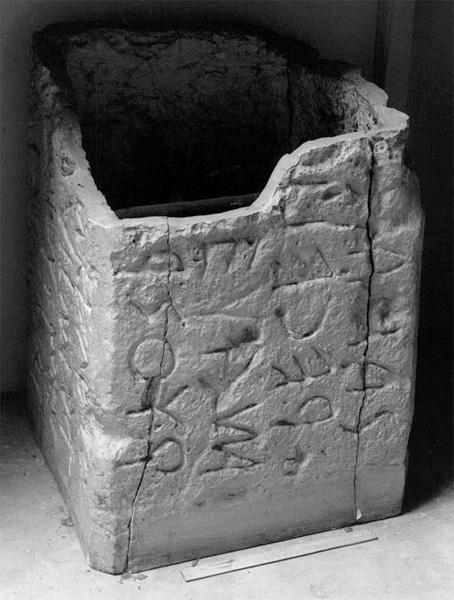
The oldest written Roman law, the Cippus concerns a function of the king, a public appearance when a special herald, the kalator went ahead of the king to clear a path through the commoners. Two sterile draft animals were involved, and violation of the kalator's orders were punishable by an animal sacrifice. The Comitium was originally a holy grove set aside for the protection of assemblies; sacral miscreants were judged there. The writing on the Cippus is of the boustrophedon type, i.e. one lines turns into the next. The writing goes forwards, backwards and even upside down, suggesting that lettering as an art-form was not yet conceived of. See R. Palmer, "The King and the Comitium", Historia 11 pamphlet 1969. |